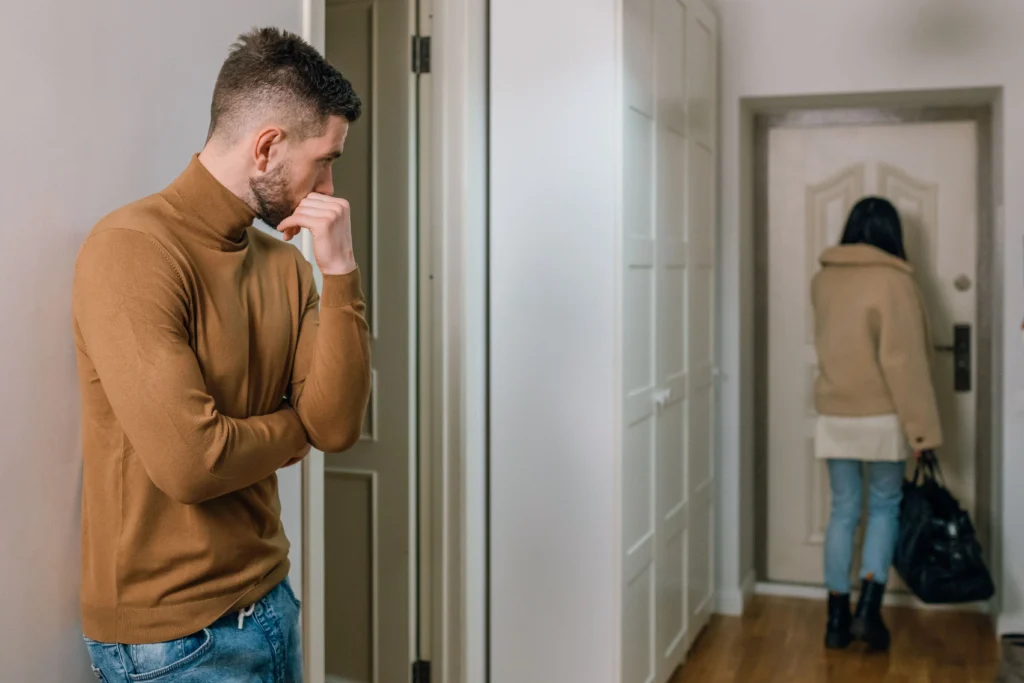

I see this pattern often and it no longer surprises me. A couple sits down and describes a well functioning household with bills paid, kids scheduled, dinners on time. And when I see them individually one of them says: “I’m more lonely in my marriage than I would be by myself.” This loneliness and lack of intimacy in a relationship is not only disappointing, it’s often destructive.
In my practice, couples who become roommates share the household, the routines, and logistics but have no access to erotic aliveness, emotional attunement, or vulnerability. And their lack of physical intimacy signals the loss of their felt sense of being desired, seen, and chosen by their partner.
No chart notes, no paper trails, no group work. If you’re in Boulder or anywhere in the US, call 303.547.8493.
How Couples Become Roommates
Most often, the erotic charge drains out of a relationship over years, quietly, through a series of small retreats no one wants to talk about.
I worked with a couple (names and identifying details changed) I’ll call Mike and Sara. Mike was a Wall Street analyst. Sara was a museum curator who had fallen in love with his curiosity and aliveness. In their early years, he would come home from the market wired, and they would talk for hours. Then promotions came and pressure mounted, and Mike went quiet – and just stopped talking about what was going on.
Over time, their conversations narrowed to groceries and logistics. Sara tried to connect and was rebuffed. Mike told her he was fine when he was not and they simply stopped talking. Ultimately, they became roommates living in the same house without access to understanding, affection, or sex.
This happened because unspoken hurts and resentments accumulated over time until honesty about these things felt too risky. Relationships without intimacy begin with not saying, not talking about, those things that are upsetting.
The Psychic Economy of Long-Term Partnership: Narcissistic Supply and Why It Matters
There’s a concept from psychoanalysis that I find more useful than almost anything else for understanding intimacy loss: narcissistic supply. I want to use that term carefully, because it has been distorted by pop psychology into something that only concerns narcissists. It doesn’t.
Originally, narcissistic supply referred to the kind of admiration, recognition, and interpersonal support that every person needs from their environment to maintain a stable sense of self. All of us need to feel desired, noticed, valued, and alive in relation to another person. That felt sense, the felt knowledge that you matter to your partner, that your presence registers, that you’re wanted and cared about, is narcissistic supply in its most fundamental form.
When I look at why physical intimacy disappears from a long-term relationship, I see it as a failure of this supply. The loss of erotic charge. The accumulated weight of resentments that was never resolved. An imbalance in who carries the emotional work of the relationship. The creeping sense of being invisible or unimportant to someone you once felt chosen by. All of these are forms of narcissistic injury, and they deplete the conditions under which desire can survive.
This is also why lack of physical intimacy in a relationship is a real risk factor for infidelity and intimacy loss. A relationship that has stopped supplying recognition, affection, and erotic charge doesn’t extinguish the drive for those things. It redirects them.
When the ROI of Commitment Runs Out
Freud introduced the concept of sublimation to describe how we channel instinctual drives, including the drive toward novelty, conquest, and erotic aliveness, into committed partnership, family, and productive work. Civilization, Freud argued, is built partly on this channeling.
But sublimation works only when the investment is returned. In my writing I indicate that sublimation will fail when there’s not enough return, not enough ROI in the relationship. That applies regardless of gender. The point isn’t that people are selfish or calculating when intimacy fails. It’s that the psychic economy of long-term love requires ongoing reciprocity: the continuing experience of feeling desired, mattered, and chosen. When that reciprocity disappears, the drive that was channeled into the relationship doesn’t simply dissolve. It goes elsewhere, through fantasy, through withdrawal, through resentment, or eventually through action.
This is a compassionate way to understand a dynamic that couples often experience as moral failure. The loss of intimacy in a marriage isn’t evidence that someone is bad at love. It’s evidence that the relationship has stopped feeding what people fundamentally require.
No chart notes. No paper trails. No group work. Everything discussed stays between us. Call 303.547.8493 to schedule a private consultation.

What We Inherit: Family-of-Origin Patterns and the Silence That Spreads
Here is something I return to repeatedly with couples: we inherit communication patterning from our family history, and it impacts how we operate at home in ways we rarely recognize. Think of it as inherited code, programming shaped by years of watching what was safe to say and what was not.
If your family of origin was laden with conflict, or thick with silence, then exposing personal or emotional information was genuinely dangerous. Superficial talk, logistics, gossip, weather, parental expectations, replaced fundamental connection. You learned that showing your actual needs was risky. And you brought that learning into your adult relationships, running it as background code in every interaction.
The roommate dynamic is often not a problem the couple created together. It’s an old pattern each person carried in separately and then enacted between them. The dinner-table silences of one partner’s childhood mesh with the conflict-avoidance learned in another’s, and gradually the marriage replicates something neither partner consciously wanted. This is why I link this pattern so directly to isolation in relationships: the mechanism is the same. Safety required closing down and habit reinforced it.
The difficulty is that this inherited code runs mostly outside conscious awareness. That’s precisely why surface-level interventions so rarely reach it.
Trust Is the Prerequisite for Physical Intimacy
Most advice on restoring physical intimacy in a relationship focuses on behavior: initiate more, schedule time together, plan date nights, use love languages. I understand why that advice exists. It’s actionable and it meets people where they feel least ashamed.
But it frequently fails, and the reason isn’t a lack of effort. Lack of trust obliterates meaningful communication, and when communication goes, there’s no room for vulnerability. Erotic aliveness requires the capacity to be genuinely seen by another person. Being seen requires trust. And trust, once it has quietly eroded through years of unspoken resentments and small withdrawals, can’t be restored through scheduling.
What I often see in couples who feel like roommates is that they’re managing each other at a careful distance. Not because they’re indifferent, but because genuine closeness has come to feel too exposing, too risky, too likely to end in misunderstanding or hurt. The psychoanalytic approach takes this seriously. You can’t technique your way back to desire. You have to understand what made closeness feel dangerous in the first place.
Waves, Islands, and Why One Partner Always Seems to Want More
When lack of intimacy in a marriage creates ongoing tension, it often follows a recognizable shape: one partner pressing for connection, the other retreating from it. This gets interpreted as one person caring more. That framing generates a lot of unnecessary shame.
Stan Tatkin, in his work on attachment (including Wired for Love), describes three attachment styles that I find consistently useful here. Waves are people who are anxiously attuned to connection, distressed by distance, and highly aware of disconnection when it occurs. Islands are people who have difficulty with closeness, are less aware of their partner’s need for connection, and tend to retreat when emotional demand increases. Anchors are securely attached people who are comfortable with interdependence and can attend to their own needs and their partner’s.
In my clinical experience, the pursuer-withdrawer cycle that defines so many roommate partnerships maps almost exactly onto the Wave-Island pairing. Typically, one person is more aware of the disconnect, more distressed by the isolation, and more urgent about reconnecting (the Wave), while the other is more shut down and less motivated toward connection (the Island). This isn’t one partner loving more. Both are adapting to something they learned about closeness. Neither attachment style is pathological. Both are the result of early relational experience, which means both can shift when the conditions for trust change.
What Lack of Intimacy Does to a Woman, and to a Man
The experience of intimacy loss isn’t identical across genders, and I think it’s worth saying so plainly.
Drawing on what I understand from both biology and clinical work: males evolved toward external novelty and territorial acquisition, while females evolved toward internal tending and relational security. These are starting points for understanding desire discrepancy, not rules about who people must be. But they do explain why the same absence of connection can register so differently between partners.
For women, a lack of physical intimacy in a relationship tends to compound into something that touches self-worth directly. There’s often a felt sense of invisibility, a growing disconnection from one’s own body and desirability, and heightened anxiety about whether the relationship has a future. The impact on women in a sexless marriage (broadly defined as fewer than 10 sexual encounters per year, which is the commonly referenced clinical benchmark) frequently includes a quiet grief that’s hard to name because it lives alongside the functional partnership that still appears intact on the surface.
For men, the same intimacy loss often manifests differently: withdrawal, irritability, a pull toward external validation, or a numbness that looks like indifference but often conceals real hurt. Neither experience is more serious than the other. Both carry genuine cost.
Relationships Without Intimacy: The Cost of Staying Disconnected
The longer a relationship sustains this kind of disconnection, the more it reshapes each person’s sense of who they are in relation to each other.
Self-worth erodes quietly. The feeling of being desirable, which most people don’t consciously track until it’s gone, starts to fade. Resentments grow and begin to feel disproportionate to specific incidents, because they’re carrying the weight of years. The friendship that once existed alongside the erotic connection often softens too, because friendship also requires a quality of presence that the roommate dynamic gradually forecloses.
The sudden loss of my partner of 30 years gave me a personal understanding of what sustained connection, followed by irreversible loss, costs. For those reading this from within a living marriage, the piece on high-achieving but lonely at home speaks to this directly. What gets left unaddressed doesn’t stay neutral.

Why Date Nights and Communication Tips Aren’t Enough
I want to be direct about this without dismissing the genuine effort people bring to trying.
Date nights, love languages, scheduled intimacy, communication scripts: these aren’t useless. They can shift the surface texture of a relationship and create brief windows of contact. But they can’t reach the implicit patterns underneath the roommate dynamic. Inherited communication shutdown, trust erosion, narcissistic injury from years of feeling unseen, and the attachment adaptations each person carries from long before they met, none of these are accessible to conscious technique. They require a different quality of attention.
The couples I see who have tried these approaches and returned to the same distance aren’t failing. They were using tools that were never designed for this depth of work. Relationship issues of this kind aren’t primarily behavioral. They’re structural, rooted in patterns that formed before the relationship began and have been reinforced by every year inside it.
Understanding those patterns is where real change becomes possible.
Finding a Space to Say What Has Gone Unsaid
What counseling provides, in the cases I analyze, is a structured space to say things that have been silenced.
This is not a fix, not a technique. It’s a place where things that feel too private, too complicated, or too dangerous to say out loud can finally be said. It’s about desire, about hurt. It’s about what you’ve missed and what you’re afraid has been lost for good.
If you recognize yourself in this, reaching out takes a certain kind of courage, especially when the problem feels overwhelming. But when you acknowledge your situation, and desire a loving relationship, you can address it.
Everything discussed stays private: no chart notes, no paper trails, no group work. I work with individuals and couples navigating intimacy loss. In person in Boulder and remotely across the US. You can schedule a consultation online, or call 303.547.8493 directly. You can also learn more about individual therapy for people who recognize that their own history is part of what needs attention.
The Roommate Dynamic Isn’t the End of the Story
The roommate dynamic isn’t a verdict on your relationship or on you. It points to something beneath the surface that hasn’t yet had a chance to be understood.
What I have tried to lay out here, through the lens of narcissistic supply and the psychic economy of partnership, through the inherited code we carry from our families of origin, through the attachment styles that shape who pursues and who retreats, and through the role of trust as the actual prerequisite for erotic aliveness, is a map of how this pattern forms. It forms quietly, over time, out of very human adaptations to pain and risk.
The question isn’t whether the connection that once existed can be reinstated. The question is whether there’s room, and willingness, to understand what closed it down. That’s a question worth sitting with honestly. Anna Frost, psychoanalyst, works with people asking exactly that question. Call 303.547.8493 to start that conversation.