

Narcissistic behavior exists on a spectrum, and most people asking this question land somewhere in the middle of it. I’ve spent 28+ years in clinical practice and wrote my doctoral dissertation on narcissism, and the question I hear most often isn’t “am I a narcissist?” It’s something quieter: why do I need this so much? That question is worth taking seriously, not as a verdict, but as an opening.
If this already feels familiar, I offer a free short consultation. Call 303.547.8493 or reach out through the contact form.
Quick Answer: What Is the Narcissism Definition and Where Does It Begin?
The narcissism definition, clinically speaking, is a spectrum. At one end: the universal human need for recognition and validation. At the other: Narcissistic Personality Disorder, defined in the DSM-5 as a pervasive pattern of grandiosity, need for admiration, and lack of empathy beginning by early adulthood. Most people, including those who worry about this, are nowhere near that threshold.
Why Everyone Needs Validation: The Developmental Root of Narcissistic Supply
The term narcissistic supply gets misused constantly. Otto Fenichel coined it in 1938 to describe something universal: admiration and interpersonal support drawn from the environment, essential to self-esteem. That’s it. It was a description of what every human being requires to develop a stable sense of self.
Infants come into the world completely dependent on attunement. When a caregiver reads the signals accurately, responding to hunger, distress, the need for closeness, something gets built in the child. With repeated attuned responses, the child begins to internalize a sense of being real, valued, and safe. That internal structure becomes the foundation for self-regulation throughout life.
The short version: we all need these supplies, and needing them isn’t a character flaw.
What Happens When Early Supply Is Inconsistent or Missing
When caregiving is inconsistent or emotionally unavailable, the child doesn’t develop that internal structure reliably. There’s no stable internal source to draw from, so the nervous system learns to seek stability externally, and it keeps seeking it into adulthood.
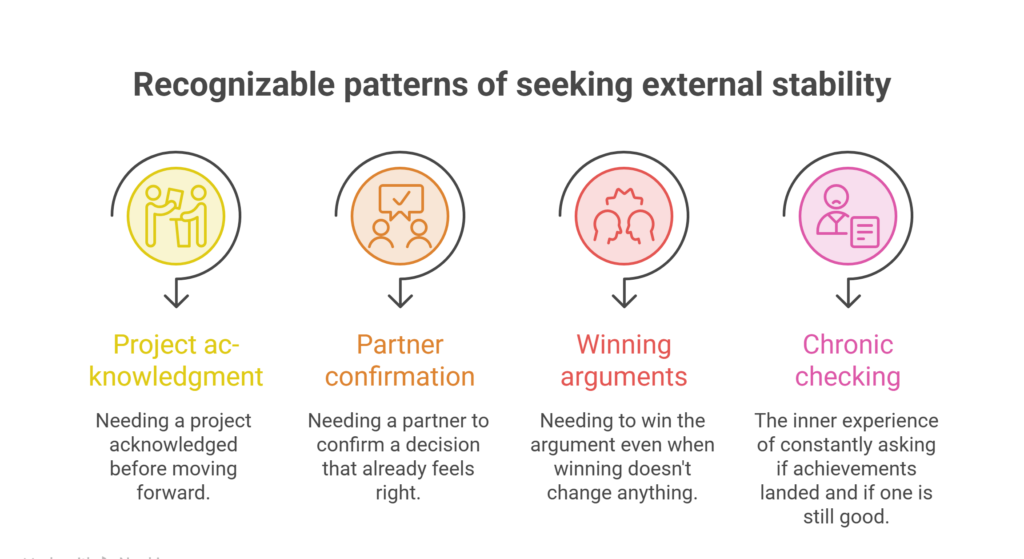
This shows up in recognizable patterns. Needing a project acknowledged before moving forward. Needing a partner to confirm a decision that already feels right. Needing to win the argument even when winning doesn’t change anything. These aren’t signs of disorder; they’re signs that the early infrastructure wasn’t built in a way that made external feedback feel optional.
For high-performing professionals, this often gets masked by output. The achievements are real. The competence is real. But the inner experience is one of chronic checking: did that land? am I still good? The performance keeps the question temporarily quiet.
The Spectrum: From Healthy Validation Seeking to Narcissistic Behavior
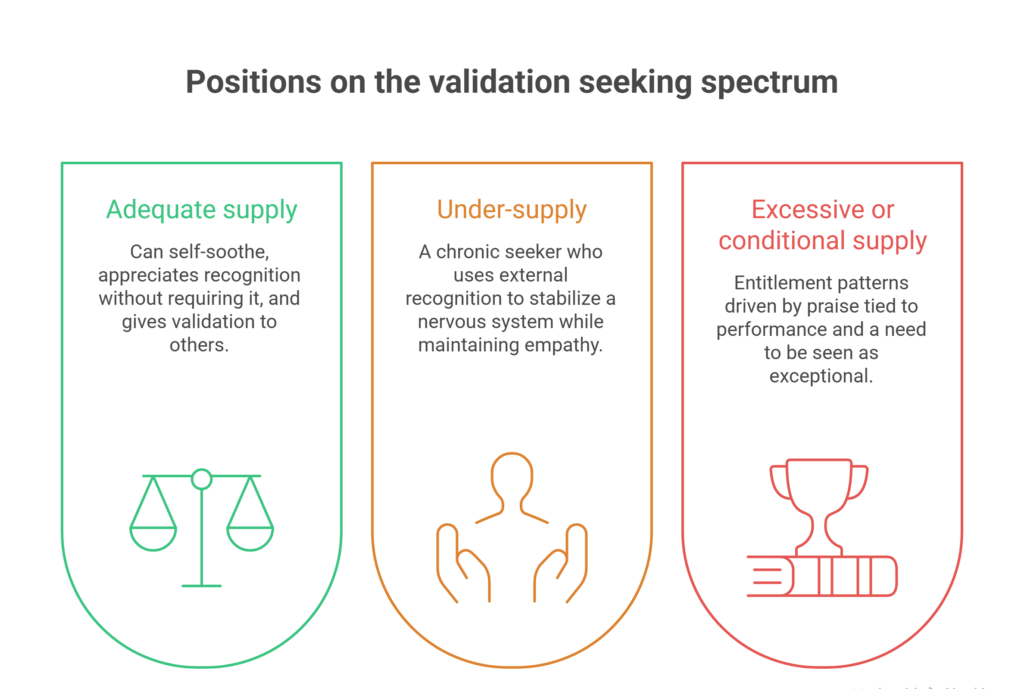
The continuum I work with has three rough positions, and where someone lands is shaped far more by their early caregiving environment than by anything they chose as adults.
The first position is adequate supply. This person can self-soothe when validation isn’t available. They appreciate recognition but don’t require it to function. They can give validation to others without feeling depleted. Relationships are places of genuine exchange, not supply chains.
The second position is under-supply. This person is a chronic seeker. They turn to relationships, professional achievement, or external recognition to stabilize a nervous system that didn’t learn to do it internally. Importantly, this person can still attune to others. They can feel empathy. The seeking is driven by deficit, not by indifference to other people.
The third position involves excessive or conditional early supply, often praise tied to performance or achievement rather than simply being. This tends to produce entitlement patterns: difficulty tolerating others’ needs when they compete with one’s own, limited reciprocity, and a self that depends on being seen as exceptional to feel stable at all.
Can someone have narcissistic tendencies but not be a narcissist? Yes, and this is important. Most people who ask that question fall into position two: chronic seeking driven by a developmental gap. The tendencies are real. The disorder is a different threshold entirely, and the self-reflection required to ask the question is itself evidence against the most severe end of the spectrum.
The High Achiever Pattern: When Performance Becomes a Supply Source
There’s a pattern I see often in my practice with high-performing clients, and it follows a specific shape. Early validation was conditional, tied to output. Good grades, winning, being the one who figured it out. The supply came, but it came with strings attached. So the person learned: produce, and you’ll be seen. Stop producing, and you won’t.
In adulthood, this becomes a full-time maintenance strategy. The promotion needs to happen to feel okay. The peer’s respect needs to be visible. The client needs to be impressed. It worked once, and it’s not wrong to want those things. But the cost of running that system is high, and at some point the output stops delivering what it promised.
It’s not about the achievements. It’s about what the achievements are being asked to carry.
Narcissism vs Narcissistic Personality Disorder: A Clinical Distinction That Matters
When I talk about narcissism vs narcissistic personality disorder, the distinction isn’t semantic. It has real consequences for how someone understands their own patterns or makes sense of someone else’s behavior.
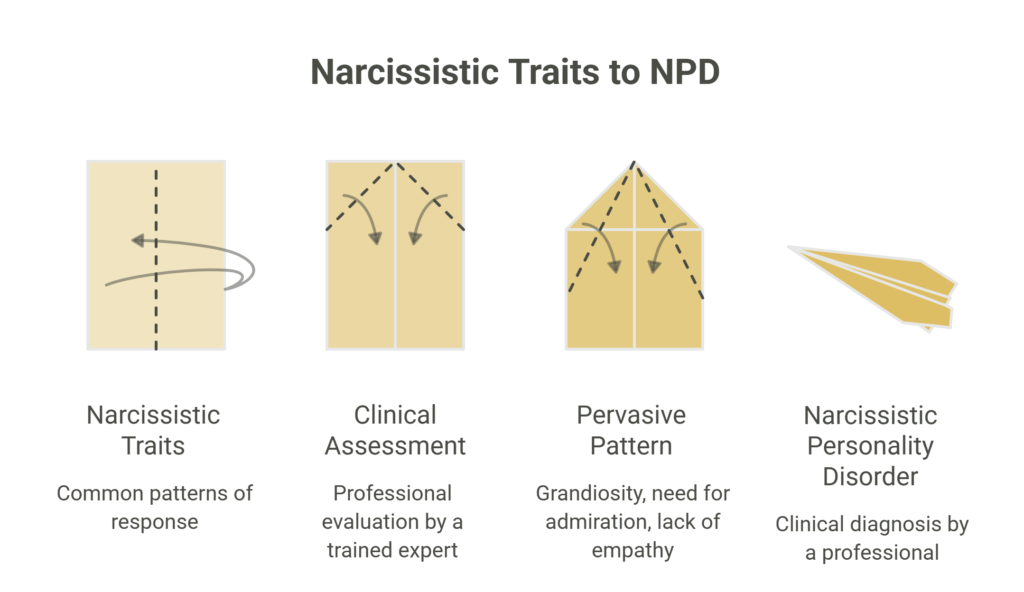
The DSM-5 defines NPD as a pervasive pattern of grandiosity, need for admiration, and lack of empathy, beginning by early adulthood and present across contexts. Two words matter most there: pervasive and lack of empathy. Not occasional. Not situational. Pervasive, across relationships, across settings, over time, with a genuine inability to recognize or care about others’ inner experience.
Narcissistic personality disorder symptoms require clinical assessment by a trained professional. They don’t emerge from a checklist or a search engine. And the person who is searching for that assessment, who wonders whether their patterns have crossed a line, is almost never the person who meets NPD criteria. The disorder involves a limited capacity for this kind of self-reflection. The very act of asking is a differentiating factor.
The Difference Between Narcissistic Traits and a Narcissist
Narcissistic traits exist in all people. A trait is a pattern of response, not an identity. Deflecting when criticized, withdrawing when recognition isn’t forthcoming, needing more reassurance than feels rational: these are patterns. They have roots. They can be understood and shifted.
The question about the difference between a narcissist and a manipulator comes up clinically, and it’s worth addressing directly. Not all manipulative behavior is narcissistic, and not all narcissistic behavior is consciously manipulative. Many relational strategies that look manipulative, things like deflection, blame, or strategic withdrawal, are actually anxiety-driven defense patterns rooted in supply deficits. The person isn’t calculating harm. They’re protecting an internal structure that feels fragile. That distinction changes everything about how the work proceeds.
Why Do I Need Validation from Others? The Question Worth Sitting With
If you’re asking this question, I want to reframe it slightly. The fact that you’re asking isn’t a sign of weakness or a signal that something is badly wrong. It’s information. The nervous system is pointing somewhere.
Needing validation from others isn’t a character flaw. When internal stability wasn’t built reliably in early life, the nervous system learned to regulate through external input. That strategy made complete sense given what was available. The problem isn’t that the strategy existed. The problem is that it costs more than it returns in adult relationships, and the return is always temporary.
What I’ve found more useful than trying to eliminate the need is getting curious about it. Which situations trigger the need most intensely? A specific kind of criticism? A particular type of silence? The absence of acknowledgment from someone whose opinion carries unusual weight? The pattern, when you look closely, almost always points back to something specific about what was missing or conditional early on. That’s not an accusation. It’s a map.
When Validation Seeking Starts to Damage Relationships
In my published work, I’ve framed this directly: if we don’t get enough supply, our relationships become a search for validation, leading to patterns of disconnection, anxiety, and potential burnout. This isn’t theoretical. I see it regularly.
It shows up as constant reassurance-seeking that the partner can’t sustain. It shows up as interpreting a neutral response as rejection, then withdrawing before the other person has even registered that something happened. It shows up as needing the partner to confirm worth repeatedly, and when they stop, the relationship begins to feel like it has failed, even when nothing obvious changed.
The person doing this isn’t doing it deliberately. They’re managing an internal system that can’t find equilibrium on its own. But the relational cost is real. The partner begins to feel like a supply source rather than a person, and at some point that dynamic breaks things. Understanding what causes relationship dysfunction at this level changes what’s possible to address.
How to Stop Seeking Validation from Others: What Actually Helps
The goal isn’t to eliminate the need for validation. That’s the wrong target, and chasing it usually just produces shame. The goal is to build enough internal infrastructure that seeking validation becomes a choice rather than a compulsion.
That shift doesn’t happen through insight alone. It happens through relational experience, specifically through the kind of attuned, consistent relationship that provides what was missing early on. The psychoanalytic frame I work within takes this seriously: the therapeutic relationship itself is part of the mechanism. Not just a container for the work, but an active ingredient.
What I call emotional availability is the foundational infrastructure here. It’s not a skill set. It’s not the same as emotional intelligence or resilience. It’s the groundwork on which skills become possible at all. In individual work, we build that infrastructure where the original gaps were.

A Note from My Clinical Work: What This Looks Like in Practice
My dissertation focused on narcissism, and I’ve spent the last 28+ years watching how the theoretical framework meets real people. The pattern that has surprised me most is how often the highest-performing clients carry the most fragile internal stability. The achievement isn’t compensating for the deficit. It’s proof the strategy is working, right up until it stops working.
The moment that shifts in a session, when someone stops performing for me and starts actually asking a question they don’t have an answer to, is when the real work begins. My own personal analysis taught me that this shift is available to anyone willing to stay in the room with it. That’s not a metaphor. It took time and willingness to get there myself.
If you’re curious about your own patterns in this area, I offer a free short consultation. You can reach me at 303.547.8493 or through the contact form.
What to Do If You Recognize These Patterns
Notice which relationships or contexts most reliably trigger the need for external confirmation. Get curious about what that situation might echo from earlier in your life. The goal isn’t to trace blame backward. It’s to understand the original logic, because that logic made sense once.
There’s a useful distinction between the feeling of needing validation and the act of compulsively seeking it. The feeling is information. The compulsion is the pattern. You can have the feeling without immediately acting on it, and that pause is where things start to shift.
Ask yourself honestly whether your current relational strategies are building stability over time or just temporarily borrowing it from others. If the borrowing never becomes building, that’s worth examining. If this is creating real friction in your relationships or your internal experience, that’s worth exploring with someone trained to go there with you. You can start by reading more about how narcissism shows up in relationships.
If This Resonates, Let’s Talk
Reading something like this takes a particular kind of willingness. If these patterns feel familiar, whether in yourself or in a relationship, I’d like to hear about it. I work with clients nationwide via phone and Zoom, and I offer a free short consultation as a first step. Call 303.547.8493 or get in touch here. My practice is based in Boulder, CO, and I see clients from across the US.
About Anna Frost
Anna Frost (NCPsyA, LPC002624) is a Nationally Certified Psychoanalyst and Licensed Professional Counselor with 28 years of private clinical practice. Her doctoral dissertation focused on narcissism. She holds an MA in Contemplative Psychology from Naropa University (1994), trained at the Colorado Center for Modern Psychoanalytic Studies and the Philadelphia School of Psychoanalysis, where she was certified in 2010 and now serves as a training analyst. She is the founder of Boulder Consultation in Boulder, CO, and works with clients nationwide via phone and Zoom. She has done her own relational work and brings that alongside her clinical training. You can read more on her full bio page. To explore working together, visit the individual work page.
This content is for educational purposes only and doesn’t constitute clinical advice, diagnosis, or a therapeutic relationship.