

You can build a career that others admire, hold a relationship together on the outside, and still feel privately like something essential is missing. That gap between how capable you appear and how you feel inside isn’t a flaw in your character. It may be the long shadow of childhood emotional neglect, and it has everything to do with what psychoanalysts call narcissistic supply. If you’ve been quietly carrying this, I want you to know it has a name, a history, and a way through. Call 303.547.8493 to start with a free 15-minute conversation.
What Narcissistic Supply Actually Means
Most people encounter this term in articles about recovering from a toxic ex-partner. That framing has done real damage. It has turned a developmental concept into a weapon word, and in doing so, it has cut people off from understanding something that actually applies to all of us.
The term was coined by Otto Fenichel in 1938 to describe “a type of admiration, interpersonal support drawn by an individual from their environment, essential to their self-esteem.” As I often say to the people I work with, narcissistic supply was originally about the biological need for us all to feel noticed, valued, and connected. Freud understood this as foundational to the self. Kohut built an entire theoretical framework, self-psychology, around it: the idea that we all need early experiences of mirroring and attunement to develop stable inner lives.
For a fuller account of what narcissistic supply actually means in a clinical sense, I’ve written about that in detail. The short version: it’s not a thing narcissists do to you. It’s something every human being needs from birth.
A Universal Need Rooted in Early Childhood
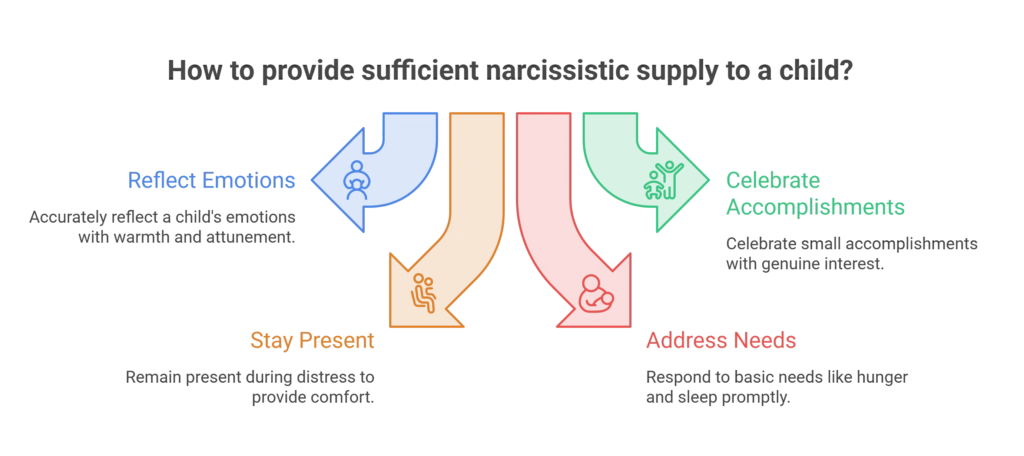
The need for narcissistic supply doesn’t begin in adulthood. It begins the moment a child arrives in the world. Infants have no way to regulate themselves; they depend entirely on a caregiver to notice their signals and respond. When a parent reads their infant’s distress and meets it with warmth, the child’s nervous system learns something foundational: I exist, my needs matter, the world is responsive to me.
I’ve asked this question for years in my clinical work, and I find it cuts right to the center of things: were your parents capable of reading and addressing your signals as an infant, as a toddler, as a teenager? Was there enough empathy and recognition for being hungry, or wet, or needing contact, or needing sleep? If those needs weren’t addressed, then the child will always be looking for someone to supply them.
Kohut called this mirroring: the moment when a parent reflects a child’s emotional experience back with genuine attunement, not correction, not distraction, just accurate recognition. When mirroring happens reliably, the child internalizes a stable sense of self. When it’s absent or unreliable, the child keeps searching for it. That search doesn’t stop at eighteen.
What Caregivers Provide (or Don’t)
What does sufficient supply look like in practice? A parent who reflects their child’s emotions accurately rather than dismissing or overriding them. A parent who celebrates a small accomplishment with real interest, not performance. A parent who stays present when a child is distressed instead of withdrawing or shutting the feeling down.
What is childhood emotional neglect on the other end of that spectrum? It isn’t necessarily dramatic. It can look like a parent who was emotionally unavailable due to their own struggles, who responded to feelings with silence or irritation, who gave approval only when the child succeeded, or who consistently treated the child’s emotional life as secondary to their own. There’s a continuum here. Most caregivers who fell short weren’t malicious. They were working from their own unexamined history, their own unmet needs.
Three Outcomes: How Supply Shapes the Self
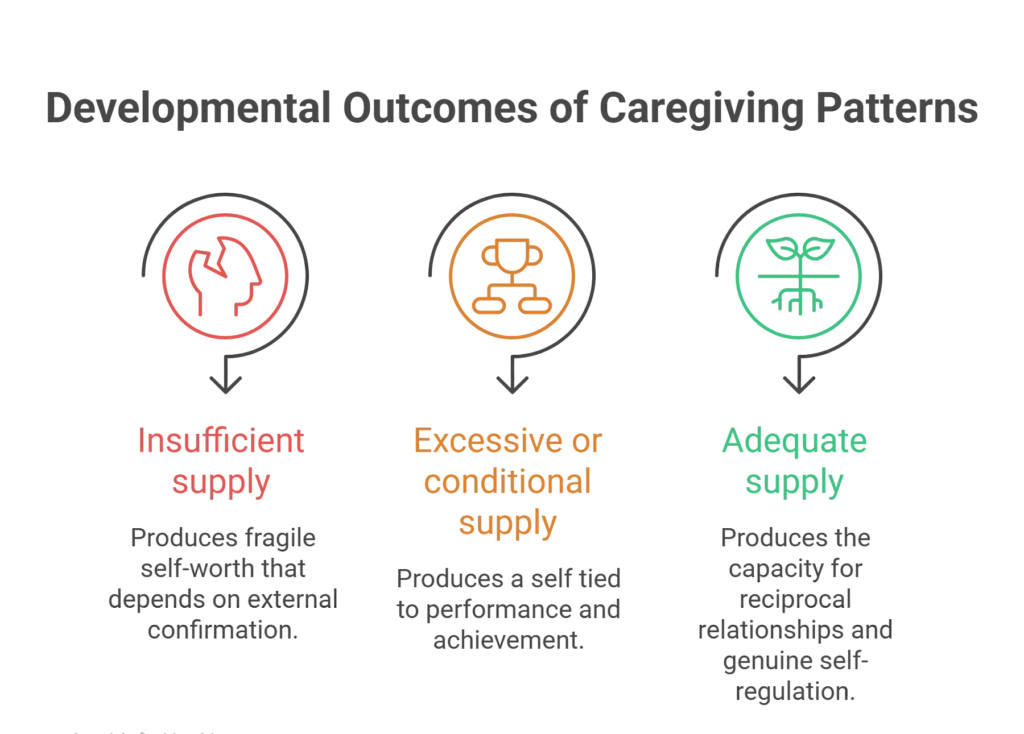
In my clinical work and in the graduate research I’ve done on this subject, I’ve observed that caregiving patterns tend to produce three recognizable developmental outcomes. These aren’t diagnoses. They’re patterns that emerged from early experience, and understanding them is often the first moment a client feels genuinely seen.
Insufficient supply produces fragile self-worth that depends on external confirmation. The adult who grew up this way tends to scan relationships for signs of approval, struggles to self-soothe when things go wrong, and can’t quite absorb genuine praise. The search for validation becomes a background hum that never fully quiets.
Excessive or conditional supply, the pattern where a child was praised primarily for achievement or appearance rather than simply for being, produces a self tied to performance. These adults often function extremely well by external measures but fall apart privately when the performance stalls or someone fails to admire them. Ordinary feedback registers as attack.
Adequate supply produces the capacity for reciprocal relationships and genuine self-regulation. Not perfection, but a settled-enough foundation that a person can tolerate criticism, receive care without suspicion, and stay in contact with their own needs. Understanding how childhood patterns drive relationship dysfunction makes these distinctions clearer in practice.
Signs of Childhood Emotional Neglect in Adulthood
What is childhood emotional neglect, in terms of how it actually presents decades later? The signs tend to be quieter than people expect. This is a wound defined by what didn’t happen, not by any specific event. There was no dramatic incident to point to, which is exactly why so many people dismiss their own history.
The profile I see most often in my practice is a high-functioning professional who appears completely fine from the outside. They’ve achieved real things. They’re respected at work. But privately, they describe a persistent feeling of not quite enough, a difficulty accepting genuine care without deflecting it, relationships that feel transactional even when they don’t want them to. They over-give, hoping connection will follow. They feel emotionally numb for stretches, or mildly flat in a way they can’t explain to others.
The signs of childhood emotional neglect in adulthood aren’t about dramatic dysfunction. They’re subtler: difficulty identifying what you need, a reflexive self-sufficiency that makes real intimacy hard, a tendency to minimize your own emotional responses, a sense of moving through relationships without ever quite landing. This connects directly to patterns of isolation in adult relationships, which I work with regularly.
A Clinical Picture: When the Outside Looks Fine
One of the people I work with was a physician in his mid-forties. Objectively accomplished, known in his field, genuinely good at his work. He came in not because he was falling apart but because something felt off and he couldn’t name it. He described his marriage as fine, his friendships as adequate, his work as satisfying. But fine and adequate kept coming up, and what didn’t come up was anything that felt real or close.
When someone offered him genuine appreciation, he deflected immediately. When his partner reached toward him, he felt something close to suspicion about her motives. He’d spent so long performing competence that he had lost contact with whatever was underneath it.
What emerged over time was a picture of a childhood where emotional attunement simply wasn’t available. His parents weren’t cruel. They were distracted, focused on external achievement, and emotionally absent in the specific way that leaves no visible marks. He’d never had a name for it. Having one changed something.
Why This Isn’t Your Fault, and Not Your Parents’ Either
I want to be careful here, because this work can slide into blame if we’re not attentive. Most caregivers who couldn’t provide sufficient supply were themselves not adequately supplied as children. The wound travels across generations not through intention but through unexamined patterns, through what no one in the family ever learned to do.
I know this personally. I married at 23 and divorced in my early 30s. Relationship after relationship failed through graduate school and beyond. I was disillusioned, heartbroken, and alone in the way that makes you question your own judgment entirely. It wasn’t until I invested in real psychoanalytic training, including years of my own analysis, that I began to understand what had been driving those patterns. That personal experience isn’t incidental to my clinical work. It’s the ground of it.
Understanding your history isn’t about assigning fault. It’s about gaining access to something that has been shaping your behavior without your knowledge or consent. Curiosity is more useful here than judgment.
You don’t Have to Keep Managing This Alone
Many of the people I work with waited a long time before reaching out. They waited until a relationship was in real trouble, until a health event forced a slowdown, or until the weight of years of this became something they couldn’t quietly carry anymore. The radiation oncologist in the composite above was explicit: it wasn’t easy to ask for help, given who he was professionally.
That hesitation is understandable. High performers are often the people others depend on. Asking for support can feel like a contradiction of identity. Understanding yourself at this level is its own kind of skilled work, and it doesn’t get done by managing harder.
If this post has named something you’ve been living with for a while, I’d encourage you to take that recognition seriously. You can explore individual therapy or read more about the anxiety-focused work I do with professionals navigating exactly this territory.
I work with clients in person in Boulder and remotely with people across the U.S. Conversations are confidential. No chart notes, no paper trails, no group work. Call 303.547.8493 or schedule a consultation and we can talk about what’s actually going on.
How to Heal from Childhood Emotional Neglect: What the Process Actually Looks Like
The question of how to heal from childhood emotional neglect is the one I care most about answering honestly, because the popular answers are mostly inadequate. Self-help books and symptom checklists don’t repair a developmental deficit. The thing that was missing was relational. A relationship is where it gets addressed.
What I mean by that specifically is a consistent, attuned therapeutic relationship with someone trained to provide the kind of recognition that wasn’t available early on. Individual relational analysis is what I offer: a process grounded in Kohut’s self-psychology and modern psychoanalytic practice, focused on understanding what put the current patterns in place and creating new options. This work literally creates new neuronal pathways in your brain. It changes your programming. But it requires willingness, persistence, and courage, not because it’s punishing but because it’s real.
Part of what surfaces in this process is how anxiety shows up in relationships as a direct result of early supply deficits. That connection between unmet developmental needs and adult anxiety is one I work with constantly. If you recognize yourself in this post, a free 15-minute consultation is a reasonable first step. Call 303.547.8493.
Self-Reflection: Noticing Your Own Supply Patterns
I want to offer something more useful than a checklist. These questions aren’t diagnostic tools. I invite you to sit with them privately, not to arrive at conclusions but to notice what comes up.
When someone offers you genuine praise, what happens in your body? Do you absorb it, deflect it, or immediately look for the catch? When you feel emotionally depleted, what do you reach for first? Do you know what you actually need from the people closest to you, and if so, can you ask for it directly? Do your relationships feel like places where you’re known, or places where you’re performing a version of yourself? Can you recall being emotionally seen as a child, even once, and how often did that happen?
What these questions tend to surface is the gap between what people learned to expect and what they actually need. That gap is where the work begins.

Why I Wrote This, and What I Bring to This Work
I’m a Nationally Certified Psychoanalyst (NCPsyA, LPC002624) with an MA in Contemplative Psychology from Naropa University (1994). I trained at the Colorado Center for Modern Psychoanalytic Studies and the Philadelphia School of Psychoanalysis, where I was certified in 2010 and where I currently serve as a training analyst.
My doctoral dissertation focused specifically on narcissism and narcissistic supply. As I’ve said directly:
“My dissertation was on that topic. It’s kind of my wheelhouse.”
That isn’t a casual claim. It means I’ve spent my academic and clinical career inside this material, not reading summaries of it.
I’ve also walked this path personally. That matters because it means I’m not asking clients to do anything I haven’t done myself. You can read more about my background and training on my Anna Frost, NCPsyA page.
You don’t Have to Keep Carrying This Alone
The central argument of this post is simple: narcissistic supply is a developmental need that every human being has, not a pathology exclusive to people with narcissistic personality disorder. When that supply was chronically insufficient in childhood, the effects show up across a lifetime in ways that are real, nameable, and workable.
If any of this named something you’ve been quietly carrying, I would be glad to talk. I offer a free 15-minute consultation, no obligation, no charge. You can reach me at 303.547.8493 or schedule a free consultation online. I work with clients across all US time zones via phone and Zoom, with in-person sessions available here in Boulder, Colorado.
I work with high-performing leaders who excel professionally but often struggle in their personal lives. Together, we clarify values, creating new neuronal pathways in your brain. This evidence-based process alters your programming and grants you choices previously unavailable.